

Atomic Element Vs Molecular Element
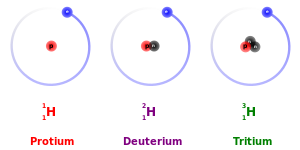
The iii naturally-occurring isotopes of hydrogen. The fact that each isotope has i proton makes them all variants of hydrogen: the identity of the isotope is given by the number of protons and neutrons. From left to right, the isotopes are protium (1H) with zero neutrons, deuterium (2H) with one neutron, and tritium (3H) with two neutrons.
Isotopes are 2 or more types of atoms that have the aforementioned atomic number (number of protons in their nuclei) and position in the periodic table (and hence vest to the aforementioned chemical element), and that differ in nucleon numbers (mass numbers) due to different numbers of neutrons in their nuclei. While all isotopes of a given element have almost the same chemical properties, they have unlike atomic masses and concrete properties.[ane]
The term isotope is formed from the Greek roots isos (ἴσος "equal") and topos (τόπος "place"), meaning "the same place"; thus, the significant backside the name is that dissimilar isotopes of a single element occupy the same position on the periodic table.[2] Information technology was coined by Scottish doctor and writer Margaret Todd in 1913 in a suggestion to the British chemist Frederick Soddy.[3]
The number of protons within the atom'southward nucleus is chosen diminutive number and is equal to the number of electrons in the neutral (non-ionized) cantlet. Each atomic number identifies a specific chemical element, but not the isotope; an atom of a given element may take a wide range in its number of neutrons. The number of nucleons (both protons and neutrons) in the nucleus is the cantlet'southward mass number, and each isotope of a given chemical element has a different mass number.
For case, carbon-12, carbon-xiii, and carbon-14 are iii isotopes of the element carbon with mass numbers 12, thirteen, and 14, respectively. The diminutive number of carbon is six, which means that every carbon atom has 6 protons so that the neutron numbers of these isotopes are 6, 7, and 8 respectively.
Isotope vs. nuclide [edit]
A nuclide is a species of an cantlet with a specific number of protons and neutrons in the nucleus, for instance carbon-13 with 6 protons and 7 neutrons. The nuclide concept (referring to individual nuclear species) emphasizes nuclear backdrop over chemic properties, whereas the isotope concept (grouping all atoms of each element) emphasizes chemical over nuclear. The neutron number has large effects on nuclear backdrop, merely its effect on chemic properties is negligible for most elements. Even for the lightest elements, whose ratio of neutron number to diminutive number varies the most between isotopes, information technology usually has only a small event although it matters in some circumstances (for hydrogen, the lightest element, the isotope effect is large enough to affect biology strongly). The term isotopes (originally also isotopic elements,[four] now sometimes isotopic nuclides [five]) is intended to imply comparing (like synonyms or isomers). For example, the nuclides 12
6 C
, 13
6 C
, fourteen
6 C
are isotopes (nuclides with the same atomic number but different mass numbers[half-dozen]), but xl
eighteen Ar
, 40
19 K
, twoscore
twenty Ca
are isobars (nuclides with the same mass number[7]). However, isotope is the older term and so is amend known than nuclide and is nonetheless sometimes used in contexts in which nuclide might be more appropriate, such every bit nuclear technology and nuclear medicine.
Note [edit]
An isotope and/or nuclide is specified by the proper name of the particular element (this indicates the atomic number) followed by a hyphen and the mass number (e.g. helium-three, helium-4, carbon-12, carbon-14, uranium-235 and uranium-239).[viii] When a chemical symbol is used, eastward.chiliad. "C" for carbon, standard notation (now known as "AZE annotation" considering A is the mass number, Z the atomic number, and E for chemical element) is to betoken the mass number (number of nucleons) with a superscript at the upper left of the chemic symbol and to indicate the atomic number with a subscript at the lower left (e.g. iii
2 He
, 4
2 He
, 12
6 C
, fourteen
6 C
, 235
92 U
, and 239
92 U
).[9] Because the atomic number is given by the element symbol, it is mutual to state simply the mass number in the superscript and leave out the diminutive number subscript (e.thousand. iii
He
, 4
He
, 12
C
, fourteen
C
, 235
U
, and 239
U
). The alphabetic character m is sometimes appended after the mass number to indicate a nuclear isomer, a metastable or energetically excited nuclear state (equally opposed to the everyman-energy ground land), for instance 180m
73 Ta
(tantalum-180m).
The common pronunciation of the AZE notation is different from how it is written: 4
two He
is commonly pronounced equally helium-four instead of 4-ii-helium, and 235
92 U
equally uranium 2-thirty-five (American English language) or uranium-ii-iii-v (British) instead of 235-92-uranium.
Radioactive, primordial, and stable isotopes [edit]
Some isotopes/nuclides are radioactive, and are therefore referred to equally radioisotopes or radionuclides, whereas others have never been observed to disuse radioactively and are referred to every bit stable isotopes or stable nuclides. For case, 14
C
is a radioactive form of carbon, whereas 12
C
and 13
C
are stable isotopes. There are about 339 naturally occurring nuclides on Globe,[10] of which 286 are primordial nuclides, significant that they have existed since the Solar System's formation.
Primordial nuclides include 34 nuclides with very long one-half-lives (over 100 meg years) and 252 that are formally considered equally "stable nuclides",[ten] because they take not been observed to decay. In nearly cases, for obvious reasons, if an chemical element has stable isotopes, those isotopes predominate in the elemental abundance found on Earth and in the Solar System. However, in the cases of three elements (tellurium, indium, and rhenium) the most abundant isotope found in nature is really one (or ii) extremely long-lived radioisotope(due south) of the element, despite these elements having i or more than stable isotopes.
Theory predicts that many manifestly "stable" isotopes/nuclides are radioactive, with extremely long one-half-lives (discounting the possibility of proton decay, which would make all nuclides ultimately unstable). Some stable nuclides are in theory energetically susceptible to other known forms of decay, such as alpha decay or double beta decay, but no decay products have yet been observed, and then these isotopes are said to be "observationally stable". The predicted half-lives for these nuclides often profoundly exceed the estimated age of the universe, and in fact, there are also 31 known radionuclides (come across primordial nuclide) with half-lives longer than the age of the universe.
Adding in the radioactive nuclides that have been created artificially, at that place are 3,339 currently known nuclides.[11] These include 905 nuclides that are either stable or accept one-half-lives longer than 60 minutes. See list of nuclides for details.
History [edit]
Radioactive isotopes [edit]
The beingness of isotopes was first suggested in 1913 by the radiochemist Frederick Soddy, based on studies of radioactive decay chains that indicated about 40 unlike species referred to as radioelements (i.e. radioactive elements) between uranium and lead, although the periodic table merely allowed for xi elements between atomic number 82 and uranium inclusive.[12] [13] [fourteen]
Several attempts to carve up these new radioelements chemically had failed.[15] For case, Soddy had shown in 1910 that mesothorium (afterward shown to exist 228Ra), radium (226Ra, the longest-lived isotope), and thorium X (224Ra) are incommunicable to separate.[xvi] Attempts to place the radioelements in the periodic tabular array led Soddy and Kazimierz Fajans independently to suggest their radioactive deportation constabulary in 1913, to the effect that alpha decay produced an chemical element two places to the left in the periodic tabular array, whereas beta decay emission produced an element one identify to the correct.[17] [18] [19] [20] Soddy recognized that emission of an alpha particle followed by two beta particles led to the formation of an element chemically identical to the initial chemical element but with a mass 4 units lighter and with unlike radioactive properties.
Soddy proposed that several types of atoms (differing in radioactive properties) could occupy the same place in the table.[14] For example, the alpha-decay of uranium-235 forms thorium-231, whereas the beta decay of actinium-230 forms thorium-230.[15] The term "isotope", Greek for "at the same place",[xiv] was suggested to Soddy by Margaret Todd, a Scottish physician and family unit friend, during a chat in which he explained his ideas to her.[sixteen] [21] [22] [23] [24] [25] He received the 1921 Nobel Prize in Chemical science in part for his work on isotopes.[26]

In the bottom correct corner of J. J. Thomson's photographic plate are the separate impact marks for the two isotopes of neon: neon-xx and neon-22.
In 1914 T. Westward. Richards found variations between the atomic weight of lead from different mineral sources, attributable to variations in isotopic composition due to different radioactive origins.[fifteen] [26]
Stable isotopes [edit]
The first evidence for multiple isotopes of a stable (not-radioactive) element was establish by J. J. Thomson in 1912 as part of his exploration into the composition of canal rays (positive ions).[27] [28] Thomson channelled streams of neon ions through parallel magnetic and electric fields, measured their deflection by placing a photographic plate in their path, and computed their mass to charge ratio using a method that became known as the Thomson's parabola method. Each stream created a glowing patch on the plate at the point it struck. Thomson observed two split up parabolic patches of light on the photographic plate (see prototype), which suggested two species of nuclei with dissimilar mass to charge ratios.
F. W. Aston afterwards discovered multiple stable isotopes for numerous elements using a mass spectrograph. In 1919 Aston studied neon with sufficient resolution to bear witness that the 2 isotopic masses are very close to the integers twenty and 22 and that neither is equal to the known tooth mass (20.ii) of neon gas. This is an example of Aston's whole number rule for isotopic masses, which states that big deviations of elemental molar masses from integers are primarily due to the fact that the element is a mixture of isotopes. Aston similarly showed in 1920 that the molar mass of chlorine (35.45) is a weighted average of the nearly integral masses for the ii isotopes 35Cl and 37Cl.[29] [thirty]
Variation in properties between isotopes [edit]
Chemical and molecular properties [edit]
A neutral cantlet has the same number of electrons as protons. Thus unlike isotopes of a given chemical element all have the same number of electrons and share a like electronic structure. Because the chemic behavior of an cantlet is largely adamant past its electronic structure, different isotopes exhibit nearly identical chemical behavior.
The main exception to this is the kinetic isotope upshot: due to their larger masses, heavier isotopes tend to react somewhat more slowly than lighter isotopes of the same element. This is most pronounced past far for protium ( 1
H
), deuterium ( 2
H
), and tritium ( 3
H
), considering deuterium has twice the mass of protium and tritium has iii times the mass of protium.[31] These mass differences also touch on the behavior of their corresponding chemical bonds, past changing the centre of gravity (reduced mass) of the atomic systems. However, for heavier elements, the relative mass difference betwixt isotopes is much less so that the mass-difference effects on chemical science are usually negligible. (Heavy elements also have relatively more neutrons than lighter elements, and so the ratio of the nuclear mass to the collective electronic mass is slightly greater.) At that place is as well an equilibrium isotope event.

Isotope half-lives. Z = number of protons. N = number of neutrons. The plot for stable isotopes diverges from the line Z = N equally the chemical element number Z becomes larger
Similarly, two molecules that differ just in the isotopes of their atoms (isotopologues) take identical electronic structures, and therefore almost indistinguishable concrete and chemical properties (again with deuterium and tritium being the primary exceptions). The vibrational modes of a molecule are determined by its shape and by the masses of its constituent atoms; and so different isotopologues have different sets of vibrational modes. Considering vibrational modes allow a molecule to blot photons of corresponding energies, isotopologues have different optical properties in the infrared range.
Nuclear properties and stability [edit]
Atomic nuclei consist of protons and neutrons bound together past the residual stiff force. Because protons are positively charged, they repel each other. Neutrons, which are electrically neutral, stabilize the nucleus in 2 ways. Their copresence pushes protons slightly apart, reducing the electrostatic repulsion between the protons, and they exert the bonny nuclear force on each other and on protons. For this reason, 1 or more than neutrons are necessary for 2 or more than protons to bind into a nucleus. Equally the number of protons increases, so does the ratio of neutrons to protons necessary to ensure a stable nucleus (see graph at correct). For instance, although the neutron:proton ratio of iii
2 He
is 1:2, the neutron:proton ratio of 238
92 U
is greater than 3:ii. A number of lighter elements accept stable nuclides with the ratio one:1 (Z = N). The nuclide 40
20 Ca
(calcium-40) is observationally the heaviest stable nuclide with the aforementioned number of neutrons and protons. All stable nuclides heavier than calcium-40 contain more neutrons than protons.
Numbers of isotopes per chemical element [edit]
Of the 80 elements with a stable isotope, the largest number of stable isotopes observed for any element is 10 (for the element tin). No element has nine or eight stable isotopes. Five elements take seven stable isotopes, eight have six stable isotopes, 10 have five stable isotopes, ix accept four stable isotopes, five have 3 stable isotopes, 16 accept 2 stable isotopes (counting 180m
73 Ta
as stable), and 26 elements accept but a single stable isotope (of these, 19 are then-called mononuclidic elements, having a unmarried primordial stable isotope that dominates and fixes the atomic weight of the natural chemical element to loftier precision; 3 radioactive mononuclidic elements occur every bit well).[32] In total, there are 252 nuclides that have not been observed to disuse. For the lxxx elements that take one or more than stable isotopes, the boilerplate number of stable isotopes is 252/80 = 3.15 isotopes per chemical element.
Even and odd nucleon numbers [edit]
| p, n | EE | OO | EO | OE | Full |
|---|---|---|---|---|---|
| Stable | 146 | v | 53 | 48 | 252 |
| Long-lived | 22 | 4 | 3 | five | 34 |
| All primordial | 168 | 9 | 56 | 53 | 286 |
The proton:neutron ratio is not the only factor affecting nuclear stability. It depends also on evenness or oddness of its diminutive number Z, neutron number N and, consequently, of their sum, the mass number A. Oddness of both Z and N tends to lower the nuclear binding energy, making odd nuclei, more often than not, less stable. This remarkable difference of nuclear bounden energy betwixt neighbouring nuclei, particularly of odd-A isobars, has of import consequences: unstable isotopes with a nonoptimal number of neutrons or protons decay by beta disuse (including positron emission), electron capture, or other less common decay modes such as spontaneous fission and cluster decay.
The bulk of stable nuclides are even-proton-fifty-fifty-neutron, where all numbers Z, Northward, and A are fifty-fifty. The odd-A stable nuclides are divided (roughly evenly) into odd-proton-even-neutron, and fifty-fifty-proton-odd-neutron nuclides. Stable odd-proton-odd-neutron nuclei are the least common.
Fifty-fifty diminutive number [edit]
The 146 fifty-fifty-proton, even-neutron (EE) nuclides comprise ~58% of all stable nuclides and all have spin 0 because of pairing. At that place are also 24 primordial long-lived fifty-fifty-even nuclides. As a result, each of the 41 fifty-fifty-numbered elements from 2 to 82 has at least one stable isotope, and most of these elements have several primordial isotopes. Half of these even-numbered elements have six or more stable isotopes. The farthermost stability of helium-iv due to a double pairing of 2 protons and ii neutrons prevents any nuclides containing five ( 5
2 He
, 5
3 Li
) or eight ( 8
iv Be
) nucleons from existing for long plenty to serve as platforms for the buildup of heavier elements via nuclear fusion in stars (see triple blastoff process).
| Decay | One-half-life | |
|---|---|---|
| 113 48 Cd | beta | 7.7×10 15 a |
| 147 62 Sm | alpha | 1.06×10 xi a |
| 235 92 U | alpha | vii.04×10 viii a |
53 stable nuclides accept an even number of protons and an odd number of neutrons. They are a minority in comparison to the even-even isotopes, which are about 3 times equally numerous. Among the 41 even-Z elements that accept a stable nuclide, but two elements (argon and cerium) have no even-odd stable nuclides. Ane element (tin) has three. There are 24 elements that have ane fifty-fifty-odd nuclide and 13 that have ii odd-even nuclides. Of 35 primordial radionuclides there exist four even-odd nuclides (encounter table at right), including the fissile 235
92 U
. Considering of their odd neutron numbers, the even-odd nuclides tend to have large neutron capture cantankerous-sections, due to the energy that results from neutron-pairing effects. These stable even-proton odd-neutron nuclides tend to be uncommon past abundance in nature, generally considering, to form and enter into primordial abundance, they must have escaped capturing neutrons to form yet other stable even-even isotopes, during both the southward-process and r-process of neutron capture, during nucleosynthesis in stars. For this reason, only 195
78 Pt
and nine
four Be
are the most naturally abundant isotopes of their element.
Odd atomic number [edit]
Forty-viii stable odd-proton-even-neutron nuclides, stabilized past their paired neutrons, form most of the stable isotopes of the odd-numbered elements; the very few odd-proton-odd-neutron nuclides incorporate the others. There are 41 odd-numbered elements with Z = ane through 81, of which 39 take stable isotopes (the elements technetium (
43 Tc
) and promethium (
61 Pm
) have no stable isotopes). Of these 39 odd Z elements, 30 elements (including hydrogen-1 where 0 neutrons is fifty-fifty) accept 1 stable odd-even isotope, and nine elements: chlorine (
17 Cl
), potassium (
19 K
), copper (
29 Cu
), gallium (
31 Ga
), bromine (
35 Br
), silver (
47 Ag
), antimony (
51 Sb
), iridium (
77 Ir
), and thallium (
81 Tl
), have two odd-fifty-fifty stable isotopes each. This makes a total 30 + two(nine) = 48 stable odd-fifty-fifty isotopes.
There are also five primordial long-lived radioactive odd-even isotopes, 87
37 Rb
, 115
49 In
, 187
75 Re
, 151
63 European union
, and 209
83 Bi
. The last two were only recently found to disuse, with half-lives greater than 1018 years.
Just five stable nuclides contain both an odd number of protons and an odd number of neutrons. The first four "odd-odd" nuclides occur in depression mass nuclides, for which changing a proton to a neutron or vice versa would lead to a very lopsided proton-neutron ratio ( 2
ane H
, vi
3 Li
, 10
five B
, and 14
7 Due north
; spins one, ane, 3, 1). The only other entirely "stable" odd-odd nuclide, 180m
73 Ta
(spin 9), is idea to be the rarest of the 252 stable isotopes, and is the simply primordial nuclear isomer, which has not yet been observed to disuse despite experimental attempts.[33]
Many odd-odd radionuclides (similar tantalum-180) with insufficiently short half-lives are known. Usually, they beta-decay to their nearby even-even isobars that have paired protons and paired neutrons. Of the nine primordial odd-odd nuclides (five stable and four radioactive with long half-lives), only 14
seven N
is the nearly common isotope of a common chemical element. This is the case considering it is a part of the CNO cycle. The nuclides six
three Li
and 10
five B
are minority isotopes of elements that are themselves rare compared to other light elements, whereas the other six isotopes make upward only a tiny percentage of the natural abundance of their elements.
Odd neutron number [edit]
| North | Even | Odd |
|---|---|---|
| Stable | 194 | 58 |
| Long-lived | 27 | vii |
| All primordial | 221 | 65 |
Actinides with odd neutron number are generally fissile (with thermal neutrons), whereas those with fifty-fifty neutron number are generally non, though they are fissionable with fast neutrons. All observationally stable odd-odd nuclides have nonzero integer spin. This is because the single unpaired neutron and unpaired proton have a larger nuclear strength attraction to each other if their spins are aligned (producing a total spin of at least one unit of measurement), instead of anti-aligned. See deuterium for the simplest example of this nuclear behavior.
Simply 195
78 Pt
, 9
iv Be
, and fourteen
7 Due north
take odd neutron number and are the most naturally abundant isotope of their element.
Occurrence in nature [edit]
Elements are composed either of one nuclide (mononuclidic elements), or of more than one naturally occurring isotopes. The unstable (radioactive) isotopes are either primordial or postprimordial. Primordial isotopes were a production of stellar nucleosynthesis or another type of nucleosynthesis such equally catholic ray spallation, and have persisted down to the present because their rate of decay is so slow (e.g. uranium-238 and potassium-twoscore). Post-primordial isotopes were created past cosmic ray bombardment as cosmogenic nuclides (due east.yard., tritium, carbon-14), or by the disuse of a radioactive primordial isotope to a radioactive radiogenic nuclide daughter (eastward.g. uranium to radium). A few isotopes are naturally synthesized equally nucleogenic nuclides, by another natural nuclear reaction, such equally when neutrons from natural nuclear fission are absorbed by another atom.
As discussed to a higher place, only 80 elements have any stable isotopes, and 26 of these take only i stable isotope. Thus, about two-thirds of stable elements occur naturally on Earth in multiple stable isotopes, with the largest number of stable isotopes for an chemical element existence ten, for can (
l Sn
). There are about 94 elements found naturally on Earth (upward to plutonium inclusive), though some are detected only in very tiny amounts, such every bit plutonium-244. Scientists gauge that the elements that occur naturally on Globe (some only equally radioisotopes) occur as 339 isotopes (nuclides) in total.[34] Only 252 of these naturally occurring nuclides are stable in the sense of never having been observed to disuse equally of the nowadays fourth dimension. An boosted 34 primordial nuclides (to a total of 286 primordial nuclides), are radioactive with known half-lives, simply accept half-lives longer than 100 million years, allowing them to exist from the beginning of the Solar Arrangement. Come across listing of nuclides for details.
All the known stable nuclides occur naturally on Earth; the other naturally occurring nuclides are radioactive but occur on Earth due to their relatively long one-half-lives, or else due to other ways of ongoing natural production. These include the afore-mentioned cosmogenic nuclides, the nucleogenic nuclides, and any radiogenic nuclides formed by ongoing decay of a primordial radioactive nuclide, such as radon and radium from uranium.
An additional ~3000 radioactive nuclides not found in nature take been created in nuclear reactors and in particle accelerators. Many brusque-lived nuclides not found naturally on Earth accept also been observed by spectroscopic analysis, being naturally created in stars or supernovae. An instance is aluminium-26, which is not naturally constitute on Earth but is found in affluence on an astronomical calibration.
The tabulated diminutive masses of elements are averages that business relationship for the presence of multiple isotopes with unlike masses. Earlier the discovery of isotopes, empirically determined noninteger values of atomic mass confounded scientists. For example, a sample of chlorine contains 75.8% chlorine-35 and 24.two% chlorine-37, giving an boilerplate atomic mass of 35.5 diminutive mass units.
Co-ordinate to generally accepted cosmology theory, only isotopes of hydrogen and helium, traces of some isotopes of lithium and beryllium, and perhaps some boron, were created at the Big Bang, while all other nuclides were synthesized afterwards, in stars and supernovae, and in interactions between energetic particles such as cosmic rays, and previously produced nuclides. (See nucleosynthesis for details of the various processes thought responsible for isotope production.) The respective abundances of isotopes on Earth result from the quantities formed by these processes, their spread through the milky way, and the rates of decay for isotopes that are unstable. After the initial coalescence of the Solar Arrangement, isotopes were redistributed according to mass, and the isotopic composition of elements varies slightly from planet to planet. This sometimes makes information technology possible to trace the origin of meteorites.
Atomic mass of isotopes [edit]
The diminutive mass (m r) of an isotope (nuclide) is adamant mainly by its mass number (i.e. number of nucleons in its nucleus). Small corrections are due to the binding free energy of the nucleus (run across mass defect), the slight difference in mass between proton and neutron, and the mass of the electrons associated with the atom, the latter considering the electron:nucleon ratio differs amongst isotopes.
The mass number is a dimensionless quantity. The atomic mass, on the other mitt, is measured using the atomic mass unit based on the mass of the carbon-12 cantlet. It is denoted with symbols "u" (for unified diminutive mass unit of measurement) or "Da" (for dalton).
The atomic masses of naturally occurring isotopes of an chemical element decide the standard atomic weight of the element. When the element contains North isotopes, the expression below is applied for the average atomic mass :


where m one, thou 2, ..., m N are the diminutive masses of each private isotope, and x ane, ..., x Northward are the relative abundances of these isotopes.
Applications of isotopes [edit]
Purification of isotopes [edit]
Several applications exist that capitalize on the backdrop of the diverse isotopes of a given chemical element. Isotope separation is a significant technological challenge, particularly with heavy elements such as uranium or plutonium. Lighter elements such as lithium, carbon, nitrogen, and oxygen are usually separated past gas diffusion of their compounds such as CO and NO. The separation of hydrogen and deuterium is unusual because information technology is based on chemical rather than physical properties, for example in the Girdler sulfide process. Uranium isotopes take been separated in bulk by gas diffusion, gas centrifugation, light amplification by stimulated emission of radiation ionization separation, and (in the Manhattan Projection) past a type of product mass spectrometry.
Utilize of chemical and biological properties [edit]
- Isotope analysis is the determination of isotopic signature, the relative abundances of isotopes of a given chemical element in a particular sample. Isotope analysis is oft done by isotope ratio mass spectrometry. For biogenic substances in item, significant variations of isotopes of C, North, and O tin can occur. Analysis of such variations has a wide range of applications, such as the detection of cariosity in food products[35] or the geographic origins of products using isoscapes. The identification of certain meteorites as having originated on Mars is based in part upon the isotopic signature of trace gases independent in them.[36]
- Isotopic substitution can exist used to make up one's mind the mechanism of a chemic reaction via the kinetic isotope effect.
- Another mutual application is isotopic labeling, the use of unusual isotopes as tracers or markers in chemical reactions.[37] Commonly, atoms of a given element are indistinguishable from each other. However, by using isotopes of different masses, even different nonradioactive stable isotopes can be distinguished by mass spectrometry or infrared spectroscopy. For example, in 'stable isotope labeling with amino acids in prison cell civilisation (SILAC)' stable isotopes are used to quantify proteins. If radioactive isotopes are used, they can be detected by the radiation they emit (this is chosen radioisotopic labeling).
- Isotopes are usually used to determine the concentration of various elements or substances using the isotope dilution method, whereby known amounts of isotopically substituted compounds are mixed with the samples and the isotopic signatures of the resulting mixtures are adamant with mass spectrometry.
Employ of nuclear properties [edit]
- A technique similar to radioisotopic labeling is radiometric dating: using the known half-life of an unstable element, one can summate the corporeality of fourth dimension that has elapsed since a known concentration of isotope existed. The virtually widely known instance is radiocarbon dating used to decide the age of carbonaceous materials.
- Several forms of spectroscopy rely on the unique nuclear backdrop of specific isotopes, both radioactive and stable. For example, nuclear magnetic resonance (NMR) spectroscopy can be used only for isotopes with a nonzero nuclear spin. The most common nuclides used with NMR spectroscopy are 1H, 2D, 15N, xiiiC, and 31P.
- Mössbauer spectroscopy also relies on the nuclear transitions of specific isotopes, such as 57Atomic number 26.
- Radionuclides also accept important uses. Nuclear power and nuclear weapons development require relatively large quantities of specific isotopes. Nuclear medicine and radiations oncology apply radioisotopes respectively for medical diagnosis and handling.
See also [edit]
- Affluence of the chemical elements
- Bainbridge mass spectrometer
- Geotraces
- Isotopomer
- List of nuclides
- List of particles
- Mass spectrometry
- Reference materials for stable isotope analysis
- Table of nuclides
References [edit]
- ^ Herzog, Gregory F. (2 June 2020). "Isotope". Encyclopedia Britannica.
- ^ Soddy, Frederick (12 December 1922). "The origins of the conceptions of isotopes" (PDF). Nobelprize.org. p. 393. Retrieved 9 January 2019.
Thus the chemically identical elements - or isotopes, every bit I called them for the first fourth dimension in this letter to Nature, considering they occupy the same place in the Periodic Tabular array ...
- ^ "isotope—Origin and meaning". www.etymonline.com . Retrieved 21 Oct 2021.
{{cite web}}: CS1 maint: url-status (link) - ^ Soddy, Frederick (1913). "Intra-diminutive charge". Nature. 92 (2301): 399–400. Bibcode:1913Natur..92..399S. doi:10.1038/092399c0. S2CID 3965303.
- ^ "IUPAP Red Volume" (PDF). Archived from the original (PDF) on 2015-03-eighteen. Retrieved 2018-01-06 .
- ^ IUPAC Gold Book
- ^ IUPAC Golden Book
- ^ IUPAC (Connelly, N. G.; Damhus, T.; Hartshorn, R. G.; and Hutton, A. T.), Nomenclature of Inorganic Chemistry – IUPAC Recommendations 2005, The Regal Society of Chemistry, 2005; IUPAC (McCleverty, J. A.; and Connelly, N. G.), Nomenclature of Inorganic Chemistry II. Recommendations 2000, The Purple Society of Chemistry, 2001; IUPAC (Leigh, One thousand. J.), Nomenclature of Inorganic Chemistry (recommendations 1990), Blackwell Science, 1990; IUPAC, Classification of Inorganic Chemistry, Second Edition, 1970; probably in the 1958 start edition as well
- ^ This notation seems to take been introduced in the 2nd one-half of the 1930s. Before that, various notations were used, such as Ne(22) for neon-22 (1934), Ne22 for neon-22 (1935), or even Pb210 for pb-210 (1933).
- ^ a b "Radioactives Missing From The World".
- ^ "NuDat two Description". Retrieved 2 January 2016.
- ^ Choppin, G.; Liljenzin, J. O. and Rydberg, J. (1995) Radiochemistry and Nuclear Chemistry (2nd ed.) Butterworth-Heinemann, pp. 3–5
- ^ Others had also suggested the possibility of isotopes; for example:
- Strömholm, Daniel and Svedberg, Theodor (1909) "Untersuchungen über die Chemie der radioactiven Grundstoffe 2." (Investigations into the chemistry of the radioactive elements, part 2), Zeitschrift für anorganischen Chemie, 63: 197–206; see especially folio 206.
- Alexander Thomas Cameron, Radiochemistry (London, England: J. M. Dent & Sons, 1910), p. 141. (Cameron too predictable the deportation police force.)
- ^ a b c Ley, Willy (Oct 1966). "The Delayed Discovery". For Your Information. Galaxy Scientific discipline Fiction. pp. 116–127.
- ^ a b c Scerri, Eric R. (2007) The Periodic Table Oxford University Press, pp. 176–179 ISBN 0-19-530573-six
- ^ a b Nagel, Miriam C. (1982). "Frederick Soddy: From Alchemy to Isotopes". Journal of Chemical Educational activity. 59 (nine): 739–740. Bibcode:1982JChEd..59..739N. doi:10.1021/ed059p739.
- ^ Kasimir Fajans (1913) "Über eine Beziehung zwischen der Art einer radioaktiven Umwandlung und dem elektrochemischen Verhalten der betreffenden Radioelemente" (On a relation between the blazon of radioactive transformation and the electrochemical beliefs of the relevant radioactive elements), Physikalische Zeitschrift, 14: 131–136.
- ^ Soddy announced his "displacement police force" in: Soddy, Frederick (1913). "The Radio-Elements and the Periodic Law". Nature. 91 (2264): 57–58. Bibcode:1913Natur..91...57S. doi:x.1038/091057a0. S2CID 3975657. .
- ^ Soddy elaborated his displacement constabulary in: Soddy, Frederick (1913) "Radioactive decay," Chemical Society Annual Report, x: 262–288.
- ^ Alexander Smith Russell (1888–1972) also published a displacement law: Russell, Alexander S. (1913) "The periodic system and the radio-elements," Chemical News and Journal of Industrial Scientific discipline, 107: 49–52.
- ^ Soddy first used the give-and-take "isotope" in: Soddy, Frederick (1913). "Intra-atomic charge". Nature. 92 (2301): 399–400. Bibcode:1913Natur..92..399S. doi:x.1038/092399c0. S2CID 3965303.
- ^ Fleck, Alexander (1957). "Frederick Soddy". Biographical Memoirs of Fellows of the Majestic Society. 3: 203–216. doi:ten.1098/rsbm.1957.0014.
p. 208: Upward to 1913 we used the phrase 'radio elements chemically non-separable' and at that time the word isotope was suggested in a cartoon-room give-and-take with Dr. Margaret Todd in the home of Soddy's father-in-constabulary, Sir George Beilby.
- ^ Budzikiewicz H, Grigsby RD (2006). "Mass spectrometry and isotopes: a century of enquiry and discussion". Mass Spectrometry Reviews. 25 (i): 146–57. Bibcode:2006MSRv...25..146B. doi:10.1002/mas.20061. PMID 16134128.
- ^ Scerri, Eric R. (2007) The Periodic Table, Oxford Academy Press, ISBN 0-19-530573-6, Ch. 6, annotation 44 (p. 312) citing Alexander Bit, described as a one-time student of Soddy'south.
- ^ In his 1893 book, William T. Preyer also used the word "isotope" to announce similarities amidst elements. From p. 9 of William T. Preyer, Das genetische System der chemischen Elemente [The genetic system of the chemical elements] (Berlin, Federal republic of germany: R. Friedländer & Sohn, 1893): "Die ersteren habe ich der Kürze wegen isotope Elemente genannt, weil sie in jedem der sieben Stämmme der gleichen Ort, nämlich dieselbe Stuffe, einnehmen." (For the sake of brevity, I have named the former "isotopic" elements, because they occupy the same place in each of the seven families [i.e., columns of the periodic table], namely the aforementioned step [i.e., row of the periodic tabular array].)
- ^ a b The origins of the conceptions of isotopes Frederick Soddy, Nobel prize lecture
- ^ Thomson, J. J. (1912). "XIX. Farther experiments on positive rays". Philosophical Magazine. Series 6. 24 (140): 209–253. doi:10.1080/14786440808637325.
- ^ Thomson, J. J. (1910). "LXXXIII. Rays of positive electricity". Philosophical Magazine. Series 6. 20 (118): 752–767. doi:x.1080/14786441008636962.
- ^ Aston, F. W. (1920). "Isotopes and Atomic Weights". Nature. 105 (2646): 617–619. doi:10.1038/105617a0. S2CID 4267919.
- ^ Mass spectra and isotopes Francis W. Aston, Nobel prize lecture 1922
- ^ Laidler, Keith (1987). Chemical Kinetics (3rd ed.). India: Pearson Didactics. p. 427. ISBN978-81-317-0972-6.
- ^ Sonzogni, Alejandro (2008). "Interactive Chart of Nuclides". National Nuclear Data Eye: Brookhaven National Laboratory. Archived from the original on 2018-10-10. Retrieved 2013-05-03 .
- ^ Hult, Mikael; Wieslander, J. Due south.; Marissens, Gerd; Gasparro, Joël; Wätjen, Uwe; Misiaszek, Marcin (2009). "Search for the radioactivity of 180mTa using an underground HPGe sandwich spectrometer". Applied Radiation and Isotopes. 67 (5): 918–21. doi:10.1016/j.apradiso.2009.01.057. PMID 19246206.
- ^ "Radioactives Missing From The Earth". Retrieved 2012-06-16 .
- ^ Jamin, Eric; Guérin, Régis; Rétif, Mélinda; Lees, Michèle; Martin, Gérard J. (2003). "Improved Detection of Added H2o in Orange Juice past Simultaneous Determination of the Oxygen-eighteen/Oxygen-16 Isotope Ratios of H2o and Ethanol Derived from Sugars". J. Agric. Food Chem. 51 (18): 5202–vi. doi:10.1021/jf030167m. PMID 12926859.
- ^ Treiman, A. H.; Gleason, J. D.; Bogard, D. D. (2000). "The SNC meteorites are from Mars". Planet. Space Sci. 48 (12–fourteen): 1213. Bibcode:2000P&SS...48.1213T. doi:10.1016/S0032-0633(00)00105-7.
- ^ Deegan, Frances 1000.; Troll, Valentin R.; Whitehouse, Martin J.; Jolis, Ester K.; Freda, Carmela (2016-08-04). "Boron isotope fractionation in magma via crustal carbonate dissolution". Scientific Reports. 6 (1): 30774. Bibcode:2016NatSR...630774D. doi:ten.1038/srep30774. ISSN 2045-2322. PMC4973271. PMID 27488228.
External links [edit]
- The Nuclear Science spider web portal Nucleonica
- The Karlsruhe Nuclide Chart
- National Nuclear Data Center Portal to large repository of complimentary data and analysis programs from NNDC
- National Isotope Development Center Coordination and direction of the production, availability, and distribution of isotopes, and reference information for the isotope community
- Isotope Development & Production for Inquiry and Applications (IDPRA) U.S. Department of Energy program for isotope production and production research and evolution
- International Atomic Energy Bureau Homepage of International Diminutive Energy Agency (IAEA), an Bureau of the Un (UN)
- Atomic Weights and Isotopic Compositions for All Elements Static table, from NIST (National Institute of Standards and Technology)
- Atomgewichte, Zerfallsenergien und Halbwertszeiten aller Isotope
- Exploring the Tabular array of the Isotopes at the LBNL
- Current isotope research and information isotope.info
- Emergency Preparedness and Response: Radioactive Isotopes by the CDC (Centers for Disease Control and Prevention)
- Chart of Nuclides Archived 2018-ten-x at the Wayback Machine Interactive Nautical chart of Nuclides (National Nuclear Data Middle)
- Interactive Chart of the nuclides, isotopes and Periodic Table
- The LIVEChart of Nuclides – IAEA with isotope data.
- Annotated bibliography for isotopes from the Alsos Digital Library for Nuclear Issues
- The Valley of Stability (video) – a virtual "flight" through 3D representation of the nuclide chart, by CEA (France)

Atomic Element Vs Molecular Element,
Source: https://en.wikipedia.org/wiki/Isotope
Posted by: harrisontheivein1968.blogspot.com
0 Response to "Atomic Element Vs Molecular Element"
Post a Comment